Technology At Work of SWFL, Inc. (TAW) is a woman-owned car wash equipment supplier in North Fort Myers, Florida, with more than 30 years of industry experience. A used car wash machine is worth buying only if it passes a structured inspection before any money changes hands, and this guide walks through the checks that separate a reliable system from an expensive problem. It covers paperwork, wash count, cold and warm testing, wear points by machine type, controls and pay stations, Southwest Florida corrosion, and the full cost of the purchase.
TL;DR
- Get the service records, ownership documents, and wash count first, and ask whether the controller was reset or replaced.
- Watch a cold start, run a ghost wash and a test wash on a real vehicle, then recheck the hydraulics once warm.
- Inspect the load-bearing parts for your machine type: gantry and rails, high pressure system, or chain, rollers, and anti-collision system.
- Test the controller and pay station, and confirm the manufacturer still supports the model.
- For Southwest Florida equipment, check for rust, waterlogged junction boxes, and flood history.
- Price removal, rigging, installation, and missing components, and walk away if the seller blocks a test.
Start With the Paperwork and the Wash Count
Get the service records, ownership documents, and wash count before you visit a used car wash machine, and confirm the seller holds a clear title with no liens.
Wash count works like mileage on a car, and sellers quote it in listings. A 2017 Washworld Razor on Car Wash Consignment shows roughly 125,000 washes and notes that multiple motors and gearboxes were replaced over the years. Compare the count with the install year and the seller’s stated volume, and if it looks low for the machine’s age, ask whether the controller was reset or replaced.
Replacement history changes what a count means, because 125,000 washes on replaced drivetrain parts describes a different machine than the same count on original parts. Ask for a dated list of every replaced component, plus the controller’s fault log and any remote monitoring history. Oasis Car Wash Systems notes that detailed diagnostic systems tell operators exactly what failed, so a fault log records what has failed before. Regular preventative service maintenance records are key to validating a machine’s true condition.
Do a Cold Start, Then a Full Wet Cycle
Watch the machine start cold, then test it again once it is warm, because each state exposes different faults. Ask the seller to leave it off until you arrive, and note how it starts and whether movement is smooth.
A used machinery inspection guide recommends repeating the same hydraulic functions once the oil reaches working temperature, because internal leakage and wear become easier to notice as oil warms. It also lists cloudy oil and water contamination as warning signs.
Then run the machine the way operators do. The daily checklist from Professional Carwashing & Detailing pairs an unoccupied ghost wash with a test wash on a real vehicle, checking brush contact and soap application, and it flags leaks at hoses, fittings, and nozzles. Ask the seller to allow both runs.
What to Check on Each Type of Used Car Wash Machine
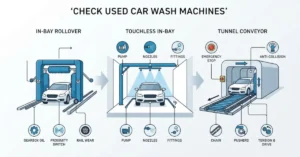
Each machine type wears in different places, so inspect the parts that carry the load for that type. Car Wash Advisory explains that tunnels move the vehicle through stationary equipment, while in-bay automatics move the equipment around a parked vehicle. TAW’s tunnel wash vs in-bay automatic comparison covers the differences in detail.
In-Bay Rollover
Run the gantry the full length of the bay and watch for stutter, drift, or drive noise. The maintenance checklist above includes proximity switches, rail wear, and monthly gearbox oil checks on friction equipment, so look at all three. In-bay automatics usually run unattended, which makes drive components and their service history the priority.
Touchless In-Bay
Focus on the high pressure system: pump, lines, nozzles, and chemical injection. Touchless washing is almost always an in-bay format, and the same checklist calls for checking nozzles for blockages and fittings for chemical and air leaks.
Tunnel Conveyor
Start with the chain, which should be tight with minimal sag according to Autobell’s director of operations. Inspect each link and roller for deterioration and loose connections, and remember that pushers wear faster than the chain. Check the tension devices, air leaks, take-up and drive sprockets, watertight junction boxes, and hydraulics free of leaks, all listed in the conveyor inspection guide. Then test the anti-collision system, which a tunnel car wash system equipment guide calls non-negotiable for safety and insurance, and the emergency stop.
Print this table for the visit.
| Machine Type | What to Inspect | Red Flag |
|---|---|---|
| In-bay rollover | Gantry travel, rails, proximity switches, brush or cloth condition, gearbox oil | Stutter or drift; worn rails; no service records for drive parts |
| Touchless in-bay | Pump, lines, nozzles, chemical injection, foaming arch | Leaks at fittings; blocked nozzles; patched lines |
| Tunnel | Chain sag, links, rollers, pushers, tension device, sprockets, junction boxes, hydraulics | Heavy chain sag; leaking hydraulics; anti-collision or emergency stop removed or bypassed |
| All types | Controller and backups, pay station, equipment room, chemical tanks | No controller backup files; failing card reader or validator; growth in tanks |
Test the Controls and Confirm the Parts Are Still Supported
Test the controller and pay station, then confirm the manufacturer still supports the model’s controls and parts. Professional Carwashing & Detailing calls the tunnel controller the brain of the wash and advises backing up controller files or keeping an emergency operations disk, so ask the seller for both and confirm they are loaded. TAW’s tech tips for car wash maintenance cover related controller and equipment upkeep guidance.
The maintenance checklist also covers car wash pay station lights, screens, keypads, voice modules, intercoms, card readers, and bill validators. Test each one.
Oasis advises checking whether local technicians can repair the equipment with standardized parts or whether proprietary components create dependency. Ask a distributor or the manufacturer to check the model and serial number against current parts and support. TAW carries ISTOBAL and Motor City Wash Works equipment. Ask too whether any warranty transfers, since Oasis reports that some manufacturers void coverage over water quality, chemical brand, or maintenance documentation.
Add Corrosion and Flood Checks for Southwest Florida Equipment
Equipment from a Southwest Florida site needs a corrosion and flood check, especially when the site sat near the coast or took storm water. A Gulf Coast field service guide for excavators and loaders explains that marine air prolongs wetness and deposits chlorides that speed rusting, and that salt spray builds corrosion products on electrical contacts. Look for rust and buildup, and confirm junction boxes and conduits are watertight.
Hurricane Ian struck the Fort Myers area on September 28, 2022 as a Category 4 storm, and Fort Myers recorded a record surge of 7.26 feet according to the National Hurricane Center tropical cyclone report. Ask the seller whether the site flooded, then inspect control panels, drives, sensors, and wiring for water lines, mud, and corrosion.
Count the Full Landed Cost, Not the Listing Price
The listing price is the first line of the total, because buyers often carry removal, transport, and missing components. A 100-foot Sonny’s, MacNeil, and Peco tunnel on Car Wash Consignment is listed at $36,000 with the buyer responsible to remove, load, and transport it, and the Razor listing states that it has no dryers, so those would be priced separately. The commercial car wash equipment guide covers current replacement cost ranges for comparison.
Budget for rigging, electrical work, plumbing, controls integration, and commissioning. Confirm the machine fits the bay dimensions, voltage, water supply, and drain layout before you commit. If you are buying a car wash business in Florida, the equipment audit is part of the due diligence.
When to Walk Away and When to Negotiate
Walk away when the seller blocks a test, cannot produce records, or has removed or bypassed a safety system. Negotiate on wear items a technician can price, such as brushes, hoses, seals, and a single gearbox.
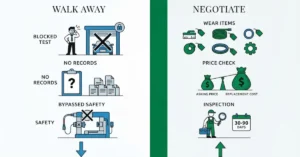
Compare the asking price with replacement cost as well. A 2026 acquisition guide puts in-bay automatic replacement at $80,000 to $250,000 per bay, so a used in-bay priced close to new needs a clear reason. In self-serve acquisitions, an operator on the Car Wash Forum suggests making part of the offer contingent on a 30 to 90 day equipment inspection.
Buy As-Is or Buy With Documented Testing
Buy as-is only when the price covers the risk your inspection found, and prefer a unit backed by documented testing when the checks cannot be completed. Documented testing means written test-run results, a condition report, and stated warranty terms, so ask every seller for all three.
The same 2026 acquisition guide puts an independent car wash equipment audit at $2K to $5K. That figure covers buying a whole wash, so request a separate quote for a single machine.
TAW lists used units on its used equipment sales page. Ask about testing, condition documentation, and warranty on any unit before buying. TAW’s in-bay automatics, tunnel systems, and service pages cover related equipment and support.
Used Car Wash Machine Inspection FAQ
How Do You Inspect a Used Car Wash Machine?
Start with the service records and wash count, watch a cold start, and run a ghost wash and a test wash on a real vehicle. Then inspect the load-bearing parts for the machine type, test the controller and pay station, and price removal and installation.
Can You Test a Used Car Wash Machine Before Buying?
Yes, and you should ask the seller to allow it. A standard operator checklist uses an unoccupied ghost wash followed by a test wash on a vehicle, checking brush contact and soap application.
How Much Does a Used Car Wash Equipment Inspection Cost?
A 2026 acquisition guide puts an independent equipment audit at $2K to $5K for buying a whole car wash. A single machine needs its own quote.
What Should You Check on Used Car Wash Equipment From Southwest Florida?
Check for rust and debris buildup, watertight junction boxes, and flood history. Fort Myers recorded a record 7.26-foot surge during Hurricane Ian in 2022, so ask every seller whether the site flooded.
About Technology At Work of SWFL, Inc.
Technology At Work of SWFL, Inc. (TAW) is a woman-owned car wash equipment supplier at 7995 Mercantile St., Unit #1, North Fort Myers, FL 33917, serving Fort Myers, Cape Coral, Lehigh Acres, Alva, Babcock Ranch, and nearby Southwest Florida communities. TAW is open Monday through Friday, 8 AM to 4 PM, and closed Saturday and Sunday. Call (239) 543-4915 or use the contact form to discuss equipment or service.