
Tap to Pay vs Card Reader vs Cash is a common comparison for car wash owners looking to improve customer convenience while controlling operating costs. A tap to pay car wash system lets a driver hold a phone or card near a reader and drive off in seconds. A card reader takes a swipe, chip, or insert and runs a few seconds slower. Cash still works, but it means coins, bills, and a box that someone has to empty.
The right choice depends on your wash type and your budget, not on which option feels newest. This guide breaks down the real costs and tradeoffs of Tap to Pay vs Card Reader vs Cash so a Fort Myers wash owner can pick the payment system that fits best.
TL;DR
- Tap to pay wins on speed and matches what customers expect at the pump and the register.
- Card readers cost less to install and work well for a bay by bay upgrade.
- Cash still has a place, but it carries theft risk and slows down every line.
- Technology At Work of SWFL, Inc. (TAW) installs and services all three systems for car wash owners across Fort Myers, FL.
Tap to Pay, Card Readers, and Cash Compared
The table below lines up the three payment types on the factors that matter most to a working car wash.
| Factor | Tap to Pay | Card Reader | Cash |
|---|---|---|---|
| Install cost | Moderate | Low to moderate | Low |
| Fee per transaction | ~2.6% + $0.10 | ~2.5% to 3% | None |
| Weather durability | Strong (sealed units) | Strong | Weak (jams, corrosion) |
| Uptime risk | Needs internet | Needs internet | None |
| Customer speed | Fastest | Fast | Slowest |
| Best fit | High traffic tunnels | Self-serve retrofits | Backup only |
Every self serve payment setup on this list can work well for the right site. TAW walks Fort Myers owners through this exact table on a site visit before recommending a system, since traffic and budget decide the winner more than the technology itself.
Why Tap to Pay Works So Well at a Car Wash
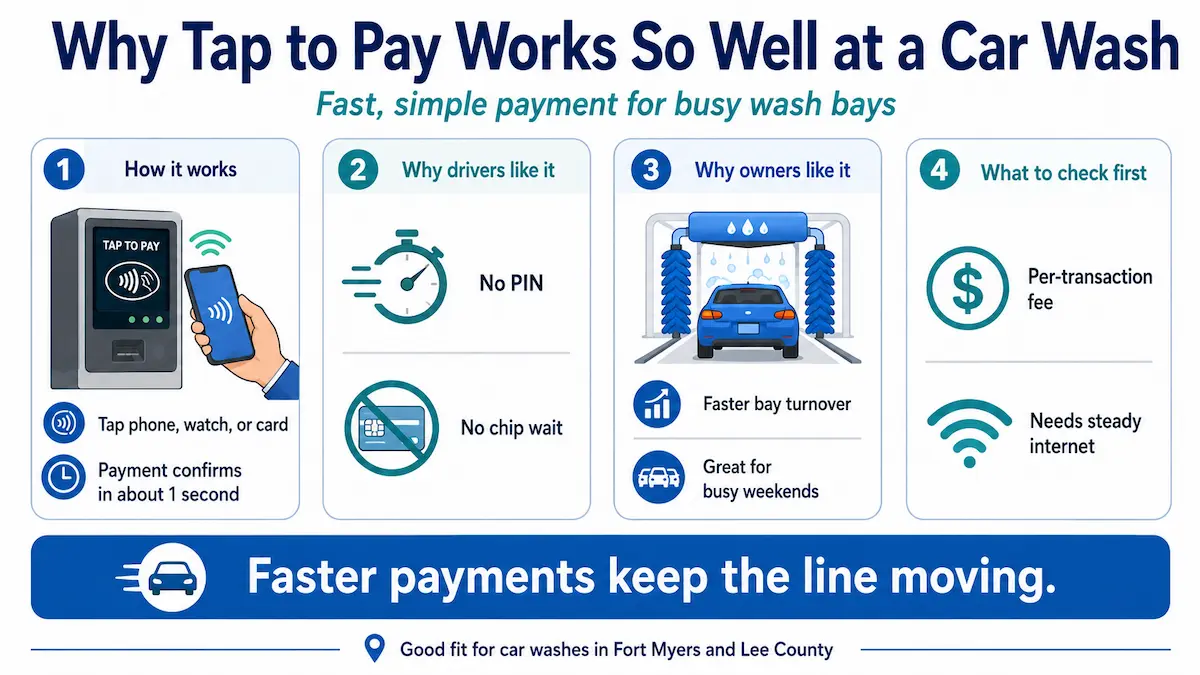
Tap to pay lets a customer hold an NFC-enabled phone, watch, or contactless card near the reader for one second. It confirms the payment right away and the wash starts, no PIN and no waiting on a chip to read.
This speed matters most at busy sites. A driver who pays with Apple Pay or Google Pay clears a bay faster than one who swipes and waits for a receipt. TAW fits this hardware into new builds and existing kiosks across Fort Myers and Lee County, including tunnel washes that see steady weekend traffic.
Tap to pay does carry a per transaction fee and it needs a steady internet connection. A wash with weak signal in the bay area should test connectivity before installing this option.
Card Readers Still Make Sense for a Retrofit
A card reader costs less to install than a full tap to pay kiosk and still lets customers pay without cash. Many self-serve car wash payment systems already run on a card reader wired into the old coin box.
This option fits an owner who wants to upgrade one bay at a time instead of replacing every unit at once. Technology At Work of SWFL, Inc. wires standalone readers into bays across Fort Myers and Lee County without touching the rest of the wash equipment.
The tradeoff is speed. A swipe or insert takes a few seconds longer than a tap, and older readers can jam in Southwest Florida’s heat and humidity.
Cash Still Has a Narrow Role
Cash carries no per transaction fee and it works with zero internet connection. That makes it a fair backup even at a wash that runs mostly on cards.
The Federal Reserve’s summary states that “cash use remained stable” and that consumers made an average of seven cash payments per month, “a number that has remained unchanged”. It also says cash was the third-most-used payment instrument after credit and debit cards, a position it held for the past five years.
The downside is real. Coin boxes jam, bills need someone to count and secure them, and a cash box is a theft target overnight. TAW still installs bill acceptors for Fort Myers owners who want a cash backup, but recommends pairing it with a card or tap option on every bay.
Self Serve Car Wash Payment Systems
A self serve bay usually runs on one reader per bay or a single terminal that manages several bays at once. The reader needs to display time remaining and let a customer add funds mid session.
For most self serve sites, a standalone tap and card reader per bay costs less and installs faster than a full kiosk. TAW builds these bay by bay upgrades for wash owners across Fort Myers, FL who want to modernize without a full rebuild. Read the Consolidated pay stations guide for a full breakdown of self serve options.
Low-Cost Car Wash Pay Stations
A budget minded owner doesn’t need a full kiosk to accept modern payments. A basic tap and card reader covers swipe, chip, and tap for a fraction of the cost of a touchscreen station.
Used and refurbished units cost less but need recertification before they meet current PCI DSS card network rules. The smart path for most small operators in the Fort Myers area is to start with one low cost reader per bay, then add features as revenue grows. Technology At Work of SWFL, Inc. stocks entry level readers built for exactly this kind of phased upgrade.
Automatic Bay Pay Stations
An in-bay automatic needs more than a simple reader. The pay station has to walk a driver through wash package choices, take payment, and trigger the wash cycle to start.
This calls for a touchscreen kiosk with clear buttons and a reliable link to the wash controller. TAW installs and configures automatic bay pay stations across Fort Myers so each wash package maps to the right cycle from day one. Browse the full lineup of car wash equipment TAW carries for in-bay automatics and tunnels.
Which System Fits Your Fort Myers Wash?
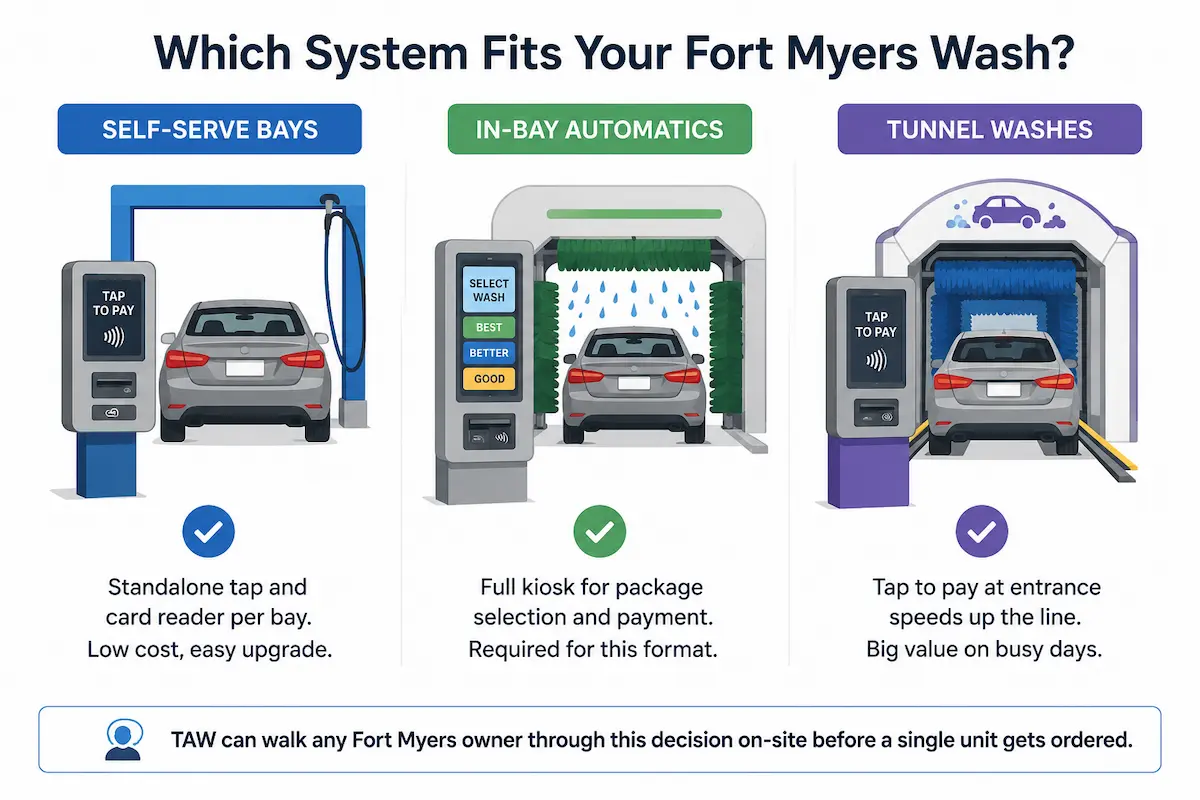
Self-serve bays do best with a standalone tap and card reader per bay. The cost stays low and the upgrade doesn’t touch the rest of the equipment.
In-bay automatics need a full kiosk that handles package selection and payment together. A simple reader can’t run the cycle selection this format requires.
Tunnel washes with steady traffic get the most value from tap to pay at the entrance. The speed gain adds up fast when cars line up on a Saturday. TAW can walk any Fort Myers owner through this decision on-site before a single unit gets ordered.
What a Wash Actually Pays Per Transaction
Take an $8 wash paid by tap to pay at 2.6% plus $0.10. The fee comes to about $0.31, leaving $7.69 for the business.
The same $8 wash on a card reader charging 3% costs about $0.24, leaving $7.76.
Cash keeps the full $8. But it adds the cost of counting, securing, and depositing bills, plus the risk of theft from an unattended box.
Over hundreds of washes a week, the gap between these fees stays small next to the labor a Fort Myers wash saves by not managing coins and bills by hand.
Frequently Asked Questions
Is tap to pay worth it for a small self-serve car wash?
Yes, for a bay with steady traffic. The speed gain and lower theft risk usually outweigh the transaction fee within the first year.
Do self-serve car washes still take cash?
Many do, as a backup option. Federal Reserve data shows cash still covers 14% of consumer payments nationwide, so some drivers still expect it.
What’s the cheapest way to add card payments to an old car wash bay?
A standalone card reader wired into the existing coin box is the lowest cost option. It adds tap, chip, and swipe without replacing the bay equipment.
How much does an automatic bay pay station cost to install?
Cost depends on the kiosk features and how much wiring the site needs. Technology At Work of SWFL, Inc. can quote an exact number after a site visit in Fort Myers, FL.
Final Word on Choosing a Tap to Pay Car Wash System
Tap to pay, card readers, and cash each solve a different problem. A wash that picks based on traffic, budget, and site conditions gets a system that pays for itself instead of one that just looks modern.
Technology At Work of SWFL, Inc. (TAW) installs, wires, and services every option covered in this guide for car wash owners in Fort Myers, FL and across Southwest Florida. Contact or call (239) 543-4915 to get a site visit scheduled and find the right payment setup for your bays.